
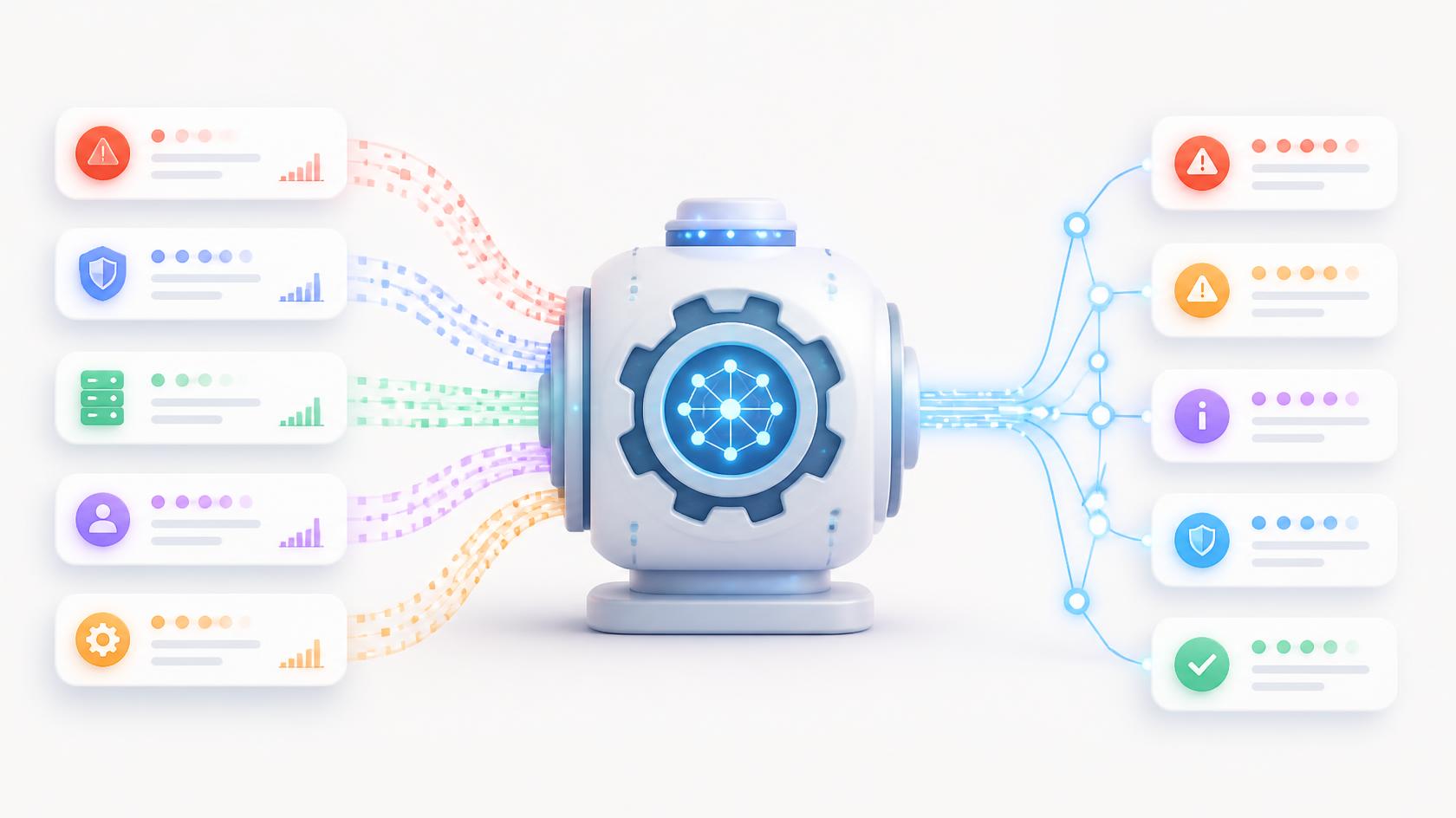
A single infrastructure issue can trigger dozens of alerts across servers, applications, endpoints, cloud services, and security tools. Without a way to connect those signals, IT teams may waste valuable time investigating symptoms instead of identifying the real cause. An incident correlation engine helps solve this problem by analyzing related events, grouping them into meaningful incidents, and highlighting the patterns that matter most. By combining event correlation, AIOps, root cause analysis, and incident management, organizations can reduce alert fatigue, improve response times, and gain clearer visibility into complex IT environments.
For cybersecurity teams, IT managers, MSPs, and business leaders, an incident correlation engine can turn fragmented operational data into actionable context.
What is an Incident Correlation Engine
An incident correlation engine is a system that analyzes events, alerts, logs, and performance signals from multiple sources to determine whether they are related.
Instead of treating every alert as a separate problem, the engine identifies connections based on factors such as:
- Time
- Device
- Application
- Service
- Location
- Dependency
- Severity
- User activity
- Network path
The result is a smaller number of meaningful incidents rather than a long list of disconnected notifications.
For example, a database slowdown may trigger application errors, API failures, user complaints, and infrastructure warnings. An incident correlation engine can connect those signals and help teams focus on the database issue as the likely root cause.
Why Incident Correlation Matters
Modern IT environments generate large volumes of telemetry.
Organizations may monitor:
- Endpoints
- Servers
- Networks
- Cloud workloads
- SaaS applications
- Databases
- Security systems
- Identity platforms
Each system can create alerts independently.
Without effective event correlation, technicians may receive several alerts for the same underlying problem.
This creates operational noise and slows response.
An incident correlation engine helps reduce that noise by organizing related events into a shared context.
Key Benefits of an Incident Correlation Engine
Reduced Alert Fatigue
Alert fatigue occurs when teams receive more notifications than they can realistically investigate.
An incident correlation engine can suppress duplicate alerts and group related events.
This helps technicians focus on high-value incidents instead of reviewing repeated notifications.
Faster Root Cause Analysis
Finding the root cause of a complex incident can take time.
An incident correlation engine helps by analyzing relationships between events.
This supports faster root cause analysis because teams can see which systems failed first and which alerts were secondary effects.
Better Incident Prioritization
Not every incident has the same business impact.
Correlation helps teams prioritize issues based on affected services, users, infrastructure, and severity.
Improved Mean Time to Resolution
When teams understand incident context faster, they can begin remediation sooner.
This can reduce Mean Time to Resolution (MTTR).
How an Incident Correlation Engine Works
The process typically begins with data collection.
The engine receives information from monitoring tools, logs, service management platforms, cloud systems, and security technologies.
Then it performs several steps.
1. Normalize the Data
Different tools may describe the same condition in different ways.
The engine standardizes incoming information into a common format.
2. Identify Relationships
The system looks for connections between events.
For example:
- Same device
- Same application
- Same time window
- Same network segment
- Same dependency chain
3. Group Related Events
Connected alerts are grouped into a single incident.
This reduces duplicate work.
4. Assign Priority
The incident may be ranked based on business impact, severity, and affected services.
5. Trigger Response
The incident can be sent to an ITSM platform, automation system, or security workflow for further action.
Event Correlation and AIOps
AIOps extends traditional event correlation by applying analytics, machine learning, and automation to operational data.
An AIOps-enabled incident correlation engine can learn from historical patterns and adapt over time.
For example, the platform may recognize that a certain server alert often appears shortly before a database issue.
Over time, the engine can use this relationship to improve prioritization.
Common AIOps Capabilities
AIOps may support:
- Anomaly detection
- Pattern recognition
- Predictive alerts
- Dynamic thresholds
- Automated incident grouping
- Root cause recommendations
- Remediation workflows
This makes AIOps especially useful in large, dynamic environments.
Incident Correlation for IT Operations
IT operations teams often manage infrastructure across data centers, cloud platforms, remote offices, and endpoints.
An incident correlation engine helps create a more unified operational view.
Network Incidents
A failed network device can generate multiple alerts across dependent systems.
Correlation can connect:
- Packet loss
- Device outages
- Application failures
- User connectivity issues
This helps teams identify the network problem more quickly.
Application Incidents
Application performance issues may involve databases, APIs, servers, or cloud services.
Correlation helps trace the relationship between these components.
Endpoint Incidents
A device with repeated failures may generate several alerts.
An incident correlation engine can group these into one case for investigation.
Cybersecurity Benefits
Security teams also benefit from correlation.
Attack activity often creates signals across multiple systems.
For example, a compromised account may generate:
- Failed login attempts
- Successful login from a new location
- Privilege escalation
- Unusual file access
- Suspicious network activity
A correlation engine can connect these events.
This gives security analysts a clearer picture of the incident.
Reduce Security Alert Noise
Security platforms often generate thousands of alerts.
Correlation helps reduce duplicate notifications and identify related events.
This improves analyst focus.
Improve Threat Investigation
By linking alerts across endpoints, identity systems, networks, and applications, teams can investigate incidents with more context.
Incident Correlation and ITSM
An incident correlation engine becomes even more valuable when integrated with incident management and ITSM workflows.
Instead of sending raw alerts to technicians, the platform can create one consolidated ticket.
That ticket may include:
- Related alerts
- Affected assets
- Severity
- Timeline
- Suspected root cause
- Business impact
- Recommended actions
This improves ticket quality and reduces repetitive work.
Automate Ticket Updates
As new events occur, the incident ticket can be updated automatically.
If remediation succeeds, the ticket status may also change.
This creates a more consistent incident lifecycle.
Root Cause Analysis with Correlated Data
Root cause analysis is often difficult because technicians must piece together information from different tools.
Correlation simplifies this process.
Consider a web application outage.
The monitoring stack may show:
- Database latency increases.
- Application response time rises.
- API errors appear.
- User sessions fail.
- Support tickets increase.
Without correlation, these may look like separate problems.
An incident correlation engine can connect the timeline and help teams identify the database as the likely source.
Common Use Cases
Organizations use incident correlation engines in many scenarios.
Cloud Operations
Cloud environments are dynamic.
Correlation helps teams connect changes in compute, storage, networking, and application services.
MSP Operations
MSPs manage many customer environments.
Correlation helps reduce alert volume and gives technicians a clearer view of client incidents.
Security Operations
Security teams use correlation to connect indicators across multiple tools.
Application Performance Management
Correlation helps identify dependencies between applications and infrastructure.
Network Monitoring
Network alerts can be grouped based on topology and device relationships.
How Incident Correlation Reduces Alert Fatigue
Alert fatigue is one of the biggest operational challenges for IT and security teams.
An incident correlation engine reduces fatigue through several techniques.
Deduplication
Repeated alerts from the same event are combined.
Suppression
Low-value alerts may be suppressed when a higher-level incident already explains the issue.
Dependency Awareness
If one upstream component fails, downstream alerts can be grouped under the same incident.
Priority Scoring
The system highlights incidents with the greatest business impact.
These techniques reduce noise without simply turning alerts off.
Best Practices for Incident Correlation
A correlation engine is only as useful as the data and rules supporting it.
1. Integrate High-Quality Data Sources
Connect monitoring, logging, security, asset, and service systems.
2. Maintain Accurate Dependencies
Service and infrastructure relationships improve correlation accuracy.
3. Tune Correlation Rules
Review false positives and missed relationships regularly.
4. Prioritize Business-Critical Services
Not every event deserves equal attention.
5. Connect Correlation with Automation
Use automation for predictable remediation tasks.
6. Review Incident Outcomes
Use resolved incidents to improve future correlation.
7. Reduce Duplicate Tools
Multiple tools producing the same alerts increase noise.
Common Challenges
Incident correlation is powerful, but implementation can fail if organizations ignore key issues.
Poor Data Quality
Incomplete or inconsistent data reduces correlation accuracy.
Missing Dependency Information
Without understanding relationships between systems, the engine may group incidents incorrectly.
Overly Broad Rules
Rules that are too broad can combine unrelated alerts.
Too Many Integrations
Connecting every possible source without clear purpose can create more complexity.
Lack of Governance
Correlation rules and models should have clear owners.
Actionable Steps to Improve Incident Correlation
Organizations can strengthen their approach by:
- Auditing current alert sources.
- Removing duplicate notifications.
- Connecting critical monitoring platforms.
- Mapping key service dependencies.
- Defining correlation rules.
- Prioritizing business-critical systems.
- Integrating with ITSM.
- Automating low-risk remediation.
- Reviewing false positives.
- Measuring MTTR and alert reduction.
These steps help teams move from reactive monitoring to more intelligent incident operations.
Frequently Asked Questions
Q1: What is an incident correlation engine?
An incident correlation engine analyzes events and alerts from multiple systems to identify relationships, group related signals, and create a clearer view of underlying incidents.
Q2: How does incident correlation reduce alert fatigue?
It reduces duplicate alerts, groups related events, suppresses secondary notifications, and highlights high-impact incidents.
Q3: What is the difference between event correlation and root cause analysis?
Event correlation connects related signals. Root cause analysis focuses on identifying the underlying reason the incident occurred.
Q4: Can an incident correlation engine support cybersecurity?
Yes. It can connect security events across endpoints, identity systems, networks, and applications to improve threat investigation and response.
Q5: How does AIOps improve incident correlation?
AIOps uses analytics and machine learning to identify patterns, detect anomalies, improve correlation, and support predictive or automated response.
Final Thoughts
Modern IT environments generate too many alerts for teams to investigate one by one. An incident correlation engine provides a smarter way to organize operational data, connect related events, and focus attention on the incidents that matter most.
By combining event correlation, AIOps, root cause analysis, and incident management, organizations can reduce alert fatigue, improve troubleshooting, and accelerate response. The strongest results come from accurate data, clear dependency mapping, well-tuned correlation rules, and continuous measurement.

 Loading...