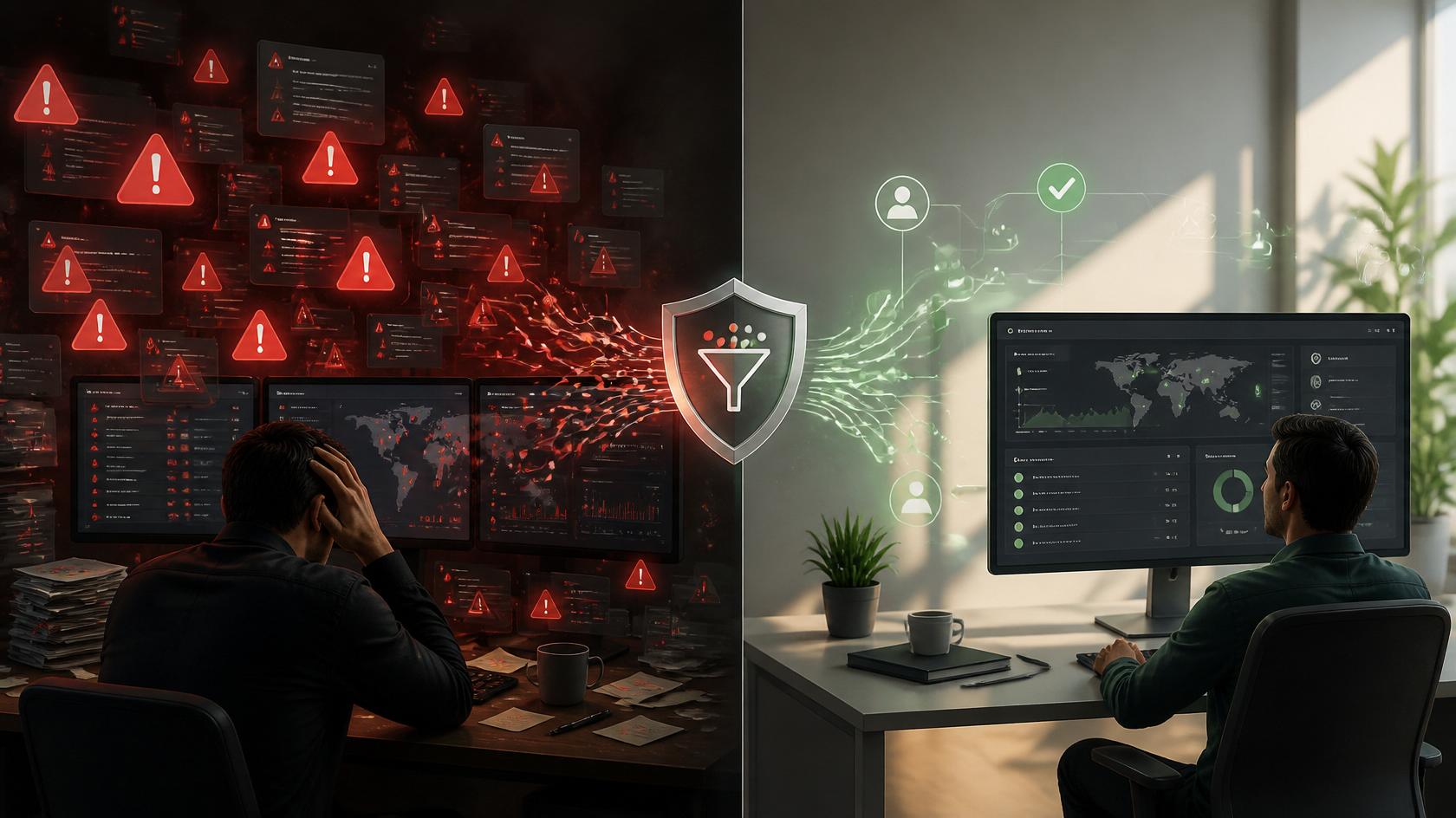
Have you ever wondered how many critical security alerts are missed simply because IT teams receive too many notifications every day? Studies show that modern Security Operations Centers (SOCs) and IT departments process thousands of alerts daily, yet a significant percentage turn out to be false positives or low-priority events. This overwhelming volume makes alert fatigue reduction one of the highest priorities for organizations looking to strengthen cybersecurity and improve operational efficiency. By implementing effective alert fatigue reduction strategies, businesses can minimize unnecessary notifications, improve incident response, and ensure security teams focus on genuine threats rather than repetitive noise.
What Is Alert Fatigue Reduction
Alert fatigue reduction is the process of minimizing excessive, duplicate, or low-value alerts generated by IT infrastructure, monitoring tools, and cybersecurity platforms. The goal is to ensure that only actionable, high-priority alerts reach IT administrators and security analysts.
Without alert fatigue reduction, teams quickly become overwhelmed by constant notifications. Over time, this can cause important alerts to be ignored or delayed, increasing the risk of security breaches and operational disruptions.
A successful alert fatigue reduction strategy focuses on improving the quality of alerts instead of simply reducing their quantity. Organizations achieve this by optimizing monitoring rules, automating repetitive tasks, and using intelligent analytics to identify meaningful events.
Why Alert Fatigue Has Become a Major Cybersecurity Challenge
Modern IT environments generate enormous amounts of operational data. Organizations now monitor:
- Endpoints
- Servers
- Cloud infrastructure
- SaaS applications
- Firewalls
- Network devices
- Identity management systems
- Email security platforms
Each solution generates its own alerts. Without centralized management, teams may receive hundreds or even thousands of notifications every day.
Common causes of alert fatigue include:
- Duplicate alerts from multiple monitoring tools
- Poorly configured thresholds
- Excessive false positives
- Lack of alert prioritization
- Legacy monitoring systems
- Rapid infrastructure growth
- Multiple security vendors generating overlapping notifications
When every notification appears urgent, security analysts struggle to distinguish critical incidents from routine events.
Why Alert Fatigue Reduction Matters
Organizations that invest in alert fatigue reduction experience measurable improvements across security and IT operations.
Faster Incident Response
Security analysts spend less time reviewing irrelevant alerts and more time responding to genuine threats.
Improved Security Visibility
By eliminating unnecessary notifications, important alerts become more visible.
Higher Team Productivity
IT administrators can focus on proactive maintenance instead of sorting through endless notifications.
Reduced Analyst Burnout
Constant alerts create stress and mental fatigue. Reducing unnecessary notifications improves employee well-being and retention.
Better Customer Experience
Faster issue resolution minimizes downtime and improves service reliability for end users.
The Business Impact of Alert Fatigue
Alert fatigue affects more than cybersecurity teams. It also impacts overall business performance.
Organizations experiencing excessive alerts often face:
- Slower problem resolution
- Increased operational costs
- Longer outages
- Reduced service availability
- Compliance risks
- Customer dissatisfaction
In highly regulated industries, delayed responses caused by alert fatigue may also contribute to audit findings and regulatory penalties.
Common Sources of Alert Fatigue
Understanding where alerts originate is the first step toward effective alert fatigue reduction.
Security Information and Event Management (SIEM)
A SIEM platform collects logs from numerous systems.
Without proper tuning, SIEM alert management can generate excessive false positives.
Endpoint Detection and Response (EDR)
EDR tools continuously monitor endpoints for suspicious behavior.
Improper configuration may trigger repeated alerts for harmless activities.
Infrastructure Monitoring
Network devices, servers, and applications constantly generate operational alerts.
Many notifications require no immediate action.
Cloud Monitoring Platforms
Cloud environments produce dynamic events that often overwhelm administrators if alert rules are not optimized.
Identity and Access Management
Authentication failures, privilege changes, and policy violations can quickly accumulate into large volumes of alerts.
Key Strategies for Effective Alert Fatigue Reduction
Reducing alert fatigue requires more than simply disabling notifications.
Prioritize Critical Alerts
Organizations should classify alerts based on business impact and security risk.
Typical priority levels include:
- Critical
- High
- Medium
- Low
- Informational
Critical alerts should always receive immediate attention.
Eliminate Duplicate Alerts
Multiple monitoring platforms frequently report the same event.
Alert correlation combines related notifications into a single actionable incident.
Optimize Alert Thresholds
Many monitoring tools use default thresholds that generate unnecessary alerts.
Organizations should customize thresholds according to:
- Business operations
- Infrastructure size
- Normal system behavior
- Risk tolerance
This significantly improves alert quality.
Implement Intelligent Filtering
Modern cybersecurity monitoring solutions use behavioral analytics and machine learning to suppress repetitive or low-value alerts while escalating anomalies that require investigation.
Automate Routine Responses
Many repetitive alerts can be resolved automatically through incident response automation.
Examples include:
- Restarting failed services
- Clearing temporary storage
- Blocking known malicious IP addresses
- Isolating compromised endpoints
- Closing duplicate incidents
Automation allows analysts to concentrate on complex investigations instead of routine maintenance.
Using Artificial Intelligence for Alert Fatigue Reduction
Artificial intelligence (AI) is transforming how organizations approach alert fatigue reduction. Traditional monitoring systems rely on static rules that often generate excessive notifications. AI-powered solutions, however, continuously learn from historical data and user behavior to distinguish between normal activity and genuine threats.
Machine learning algorithms analyze millions of events, helping security teams identify anomalies without overwhelming analysts with false alarms. As a result, organizations can reduce manual investigation time while improving threat detection accuracy.
AI also supports:
- Intelligent alert prioritization
- Behavioral anomaly detection
- Automatic alert suppression
- Threat correlation
- Predictive risk analysis
These capabilities make AI an essential component of modern cybersecurity monitoring.
The Role of SIEM Alert Management
Security Information and Event Management (SIEM) platforms are central to enterprise security operations. However, without proper configuration, they can become one of the largest contributors to alert fatigue.
Effective SIEM alert management focuses on delivering meaningful alerts rather than simply collecting large amounts of security data.
Organizations can improve SIEM performance by:
Tuning Detection Rules
Regularly reviewing detection rules helps eliminate unnecessary alerts while maintaining visibility into genuine threats.
Correlating Security Events
Instead of creating separate alerts for every event, SIEM platforms can combine related activities into a single incident.
Eliminating False Positives
Historical analysis helps identify alerts that consistently prove harmless, allowing organizations to refine detection policies.
Integrating Threat Intelligence
Threat intelligence feeds improve alert accuracy by providing context about malicious IP addresses, domains, and attack techniques.
Proper SIEM alert management dramatically improves the effectiveness of alert fatigue reduction initiatives.
How Alert Fatigue Reduction Improves Incident Response
Incident response teams depend on timely, accurate information.
When analysts receive thousands of alerts daily, identifying real threats becomes increasingly difficult.
Alert fatigue reduction improves incident response by:
- Reducing investigation time
- Prioritizing high-risk incidents
- Eliminating duplicate cases
- Improving collaboration
- Accelerating containment actions
Faster response times reduce the likelihood of attackers moving laterally through the environment or accessing sensitive information.
Alert Fatigue Reduction for Managed Service Providers
Managed Service Providers (MSPs) often monitor multiple customer environments simultaneously. Without an effective alert fatigue reduction strategy, technicians can quickly become overwhelmed.
Benefits include:
Improved Technician Productivity
Teams spend more time solving customer problems instead of reviewing unnecessary notifications.
Better SLA Performance
Critical issues are identified faster, helping MSPs consistently meet service-level agreements.
Centralized Monitoring
A unified dashboard provides visibility across multiple client environments.
Lower Operational Costs
Automation reduces repetitive manual tasks, allowing support teams to manage larger customer bases efficiently.
Enhanced Customer Satisfaction
Customers benefit from faster issue resolution and more reliable service delivery.
Best Practices for Alert Fatigue Reduction
Successful organizations treat alert fatigue reduction as an ongoing process rather than a one-time project.
Review Alert Rules Regularly
Monitoring environments evolve continuously.
Regular reviews ensure alert rules remain relevant.
Remove Obsolete Alerts
Retire notifications related to outdated applications, systems, or infrastructure.
Categorize Alerts Clearly
Establish standardized categories such as:
- Security
- Infrastructure
- Applications
- Network
- Compliance
Clear categorization improves response workflows.
Define Escalation Procedures
Every critical alert should have an established escalation path.
This minimizes confusion during high-pressure situations.
Use Automation Wherever Possible
Routine operational tasks should be automated whenever appropriate.
Automation allows skilled analysts to focus on complex investigations.
Continuously Measure Results
Organizations should evaluate alert performance regularly to identify opportunities for improvement.
Common Challenges During Alert Fatigue Reduction
Although the benefits are substantial, organizations may encounter implementation challenges.
Legacy Monitoring Systems
Older tools often lack intelligent filtering capabilities.
Poor Configuration
Default settings frequently generate unnecessary notifications.
Rapid Infrastructure Growth
Cloud adoption and remote work significantly increase monitoring complexity.
Multiple Security Solutions
Different vendors often generate overlapping alerts.
Limited Security Resources
Smaller teams may struggle to maintain monitoring configurations without automation.
Recognizing these challenges helps organizations develop more effective alert management strategies.
Measuring the Success of Alert Fatigue Reduction
Organizations should monitor key performance indicators to evaluate their alert fatigue reduction efforts.
Alert Volume
Track the total number of alerts generated daily.
A gradual reduction often indicates improved monitoring efficiency.
False Positive Rate
Lower false positive rates demonstrate better detection accuracy.
Mean Time to Detect (MTTD)
Faster detection improves overall security posture.
Mean Time to Respond (MTTR)
Reduced response times indicate greater operational efficiency.
Analyst Productivity
Monitor the number of incidents successfully resolved by each analyst.
Security Incident Outcomes
Successful alert fatigue reduction should improve the identification and containment of genuine threats.
Future Trends in Alert Fatigue Reduction
Technology continues to improve how organizations manage security alerts.
AI-Driven Security Operations
Artificial intelligence will continue reducing manual analysis through intelligent decision-making.
Predictive Analytics
Future platforms will identify high-risk situations before alerts occur.
Extended Detection and Response (XDR)
XDR platforms combine data from endpoints, networks, email, cloud, and identity systems to provide unified visibility.
Autonomous Incident Response
Automation will increasingly resolve low-risk incidents without human intervention.
Context-Aware Alerting
Future monitoring platforms will incorporate business context when determining alert severity.
These innovations will make alert fatigue reduction even more effective as security environments become increasingly complex.
Actionable Steps to Improve Alert Fatigue Reduction
Organizations looking to strengthen cybersecurity operations should:
- Audit all existing monitoring tools.
- Remove duplicate alert sources.
- Prioritize alerts based on business impact.
- Fine-tune SIEM alert management rules.
- Implement incident response automation.
- Integrate threat intelligence feeds.
- Automate repetitive operational tasks.
- Review alert thresholds quarterly.
- Measure analyst workload regularly.
- Continuously optimize cybersecurity monitoring processes.
These practical steps help organizations improve efficiency while reducing operational risk.
Frequently Asked Questions
Q1: What is alert fatigue reduction?
Alert fatigue reduction is the process of minimizing excessive, duplicate, and low-value alerts so IT and security teams can focus on genuine incidents.
Q2: Why is alert fatigue reduction important?
It improves productivity, reduces analyst burnout, accelerates incident response, and strengthens cybersecurity operations.
Q3: How does AI help with alert fatigue reduction?
AI analyzes historical patterns, suppresses false positives, prioritizes high-risk events, and automates routine investigations.
Q4: What role does SIEM alert management play?
SIEM alert management centralizes security events, correlates related alerts, and helps reduce unnecessary notifications through rule optimization.
Q5: Which organizations benefit most from alert fatigue reduction?
Enterprises, managed service providers, healthcare organizations, financial institutions, government agencies, and any business operating a Security Operations Center benefit significantly.
Final Thoughts
As cyber threats continue to evolve, organizations cannot afford to overwhelm their security teams with excessive notifications. Alert fatigue reduction enables IT and cybersecurity professionals to focus on the incidents that truly matter by eliminating unnecessary alerts, improving visibility, and accelerating response times. Through intelligent automation, optimized security alert management, effective SIEM alert management, robust incident response automation, and continuous cybersecurity monitoring, businesses can strengthen their security posture while improving operational efficiency. Investing in alert fatigue reduction today helps organizations build resilient, proactive, and scalable security operations for the future.

 Loading...